
BLOG
Aligning Early Maths at Home and in the Nursery
By Rebecca Oberg, Director for The Institute for the Early Years at Birth to 19, Bradford
Rebecca’s years of experience working with under 5s underpins her understanding of how young learners explore, play, and make sense of the world. In this blog, she shares practical, research-informed ideas on how connecting learning at home and in the nursery can help children build confidence, curiosity, and a love of early maths.
Leeds being named the UK’s first City of Maths is something for us all to celebrate. It sends a clear message that maths isn’t just about exams or classrooms, it’s about curiosity, confidence, and everyday life.
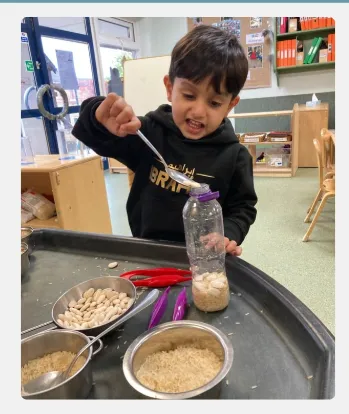
For young children, mathematical understanding begins long before formal schooling, everyday play is powerful maths learning. Filling containers in the water tray, building a den, collecting objects on a walk, or helping with cooking all involve rich mathematical thinking.
Children are counting, comparing, measuring, predicting, and problem-solving, often without realising it. These experiences build number sense, spatial awareness, and reasoning, foundations that matter and this city-wide focus recognises exactly that.
Research consistently shows that the quality of the home learning environment has a greater impact on children’s outcomes than parental education, income, or occupation (Education Endowment Foundation, 2023).
In early years settings across West and South Yorkshire, we see children making sense of the world through play: counting steps, noticing patterns, comparing sizes, and solving problems together. What really strengthens this learning is what happens beyond the nursery door. In short, it’s not who families are that matters most, it’s what they do with their children.
Alignment is crucial.
When home and setting work together, children build confidence, deepen understanding, and begin to see maths as meaningful and familiar. When children experience playful, language-rich learning in the nursery that is reinforced at home, their understanding deepens. UK longitudinal research from the EPPE study highlights this clearly. Professor Pam Sammons, one of the lead researchers, explains: “The EPPE research confirms the importance of early experiences and the powerful combination of home, pre-school and primary school in improving children’s learning.”
The EEF reinforces this message, showing that early maths skills are strong predictors of later attainment and that parental engagement has a moderate to high impact on learning outcomes. Importantly, the most effective support doesn’t come from formal teaching at home, but from everyday talk and shared experiences, noticing numbers, patterns, size, and quantity in real contexts.
Make Maths Visible
One of the most effective roles practitioners can play is making the maths visible for families.
Sharing what children are exploring in the setting and suggesting simple ways to continue the learning at home can help parents feel confident supporting learning at home. A nature walk can become an opportunity to count and sort; bath time can explore full, empty, more and less; den building can involve measuring space and using positional language.
By highlighting the maths already happening in everyday play and linking it to nursery experiences, we create a consistent, supportive learning journey. The key message for families is simple and reassuring: you don’t need formal lessons or expensive resources, learning happens when you do things together and talk about them. See how Lilycroft and St.Edmund’s Nursery Schools’ Federation have shared these messages with their families using this leaflet.
If you sometimes feel unsure about supporting maths, you’re not alone, and that’s where initiatives like NDNA Maths Champions can help.
NDNA Maths Champions
Maths Champions helps practitioners notice the maths they are already supporting, and gives simple, low-pressure ways to extend it. The EEF highlights the importance of maths talk: prompts like “How many do we have now?”, “Which one is bigger?”, or “What do you think will happen if we add one more?” encourage children to explain their thinking and build reasoning skills. You can find out more and enrol on a fully funded course here.
Looking for Maths CPD?
- Come along to our Early Years Essentials Network: Friday 20th March 2026: Using patterns to support mathematical development
- Don’t miss our Maths-focused Spring conference (more details coming soon!), where we’ll share more practical ideas, research insights, and ways to connect home and nursery learning for maximum impact.