
BLOG
Bringing Stories to Life: The Power of Props
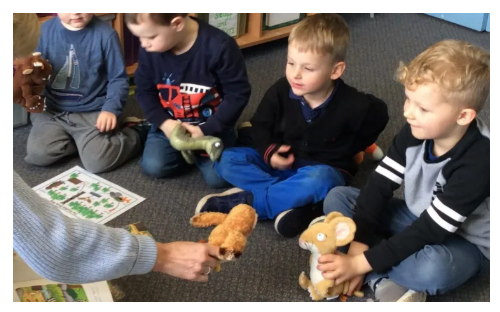
Kate’s experiences working with children under 5 and across the primary age range underpin her understanding of the power of play in developing children’s language and communication skills. In this blog she shares practical, research-informed ideas on how simple props can transform the power of storytime.
Picture your last story time. Was it a quiet circle of children listening, or a lively, interactive exchange?
In our daily practice, we know that reading to children is a fundamental part of care. But do we really take advantage of this special time
to do all we can to develop a child’s language development?
The National Year of Reading provides us with a valuable opportunity to reflect on our practice and consider how we can revitalise our storytelling sessions.
Storytelling is far more than just reading words on a page; it is a vital, language-rich experience. By simply bringing everyday props into our reading sessions, we transform abstract words into concrete, meaningful concepts. For those of us working with our youngest learners, it is a highly accessible and deeply effective intervention.
Building the Reading House
Just as we monitor developmental milestones, understanding cognitive and language milestones is crucial in supporting children’s overall learning and development. The EEF encourages us to think of early literacy as Reading House; as suggested by Hogan, Bridges, Justice and Cain (2011).
It can help us understand the fundamental role that active storytelling plays in reading comprehension. One side of the house - language comprehension - is built on the foundational ‘rooms’ of vocabulary, grammar, and syntax. When we use interactive reading strategies, we are actively helping children construct these rooms.
The evidence strongly supports this approach. According to the Education Endowment Foundation (EEF), oral language interventions in the early years are highly effective, helping children make an average of five additional months of progress. Props are a natural, evidence-based way to embed these proven strategies because they provide the vital visual and tactile cues children need to anchor new words to their actual meanings.
Evidence into Practice: Keep it Simple
You do not need a budget for expensive resources. The most effective tools are often everyday, low cost items already in your setting. A simple cardboard box becomes a house, a scarf transforms into a river, and a wooden spoon serves as any character in a story.
To put this evidence into practice this week, choose a familiar story and gather just three or four simple objects that bring the story to life. Involving the children in this process draws them further into the storytelling process.
The ShREC approach supports us in guiding our interactions, elevating a simple story time into a high quality back and forth that engages all. We don’t even need to have a book to develop these magic interactions. A selection of objects can instantly become the basis for an imaginative unique story e.g. feather, box, a colourful scarf.
- Shared attention: Get down to the child's level and notice which prop captures their focus. If they pick up a feather, follow their lead to kickstart your story, “Once upon a time there was a magic bird!”
- Respond: Listen actively to the child's ideas. Validating their thoughts encourages them to communicate freely. Use "I wonder" statements to invite imagination - for instance, "I wonder where the bird was flying to?”
- Expand: Build on the child's language. If a child points to a box and says "House!", you can expand their vocabulary: "Yes, in the magic bird house!"
- Conversation: Keep the interaction flowing. Take turns holding the props to create a continuous dialogue rather than a one-sided reading or narrative.
Call to Action
Taking a moment to reflect on our practice is how we grow to deliver the best possible care and education. Choose one familiar story you plan to share. Find 3 or 4 everyday items around your setting to use as props. After your story time, reflect on how the children interacted differently.
What one small change will you make to your storytelling practice today?